



When it comes to healthy eating, most people focus on what they should eat. Superfoods, organic ingredients, calorie counts, protein intake, and diet trends dominate health conversations today. While food quality is undoubtedly important, Ayurveda takes a broader view of nutrition.
According to Ayurveda, when you eat can be just as important, if not more important, than what you eat. Even the healthiest foods may fail to nourish the body if consumed at the wrong time or under the wrong conditions. Ayurveda teaches that digestion is governed by natural biological rhythms, and aligning meals with these rhythms is essential for optimal health.
This ancient wisdom may explain why some people eat healthy diets yet still struggle with bloating, fatigue, weight gain, and digestive issues.
The Ayurvedic Concept of Agni
At the heart of Ayurvedic nutrition lies Agni, or digestive fire. Agni is responsible for digesting food, absorbing nutrients, and transforming them into energy and tissue nourishment.
When Agni is strong, food is digested efficiently, nutrients are properly absorbed, toxins do not accumulate and energy levels remain stable.
When Agni becomes weak or irregular, digestion slows down, toxins (Ama) accumulate, nutrient absorption decreases, health problems begin to develop.
Ayurveda believes that maintaining healthy Agni is more important than following the latest diet trend.
Your Digestive Fire Changes Throughout the Day
One of Ayurveda’s most fascinating insights is that digestion follows a natural daily cycle.
Just as the sun rises, peaks, and sets, digestive fire also fluctuates throughout the day.
Morning: Gentle Digestive Fire
Early morning digestion is relatively mild. The body is still transitioning from the night’s restorative processes.
Heavy meals immediately after waking may overwhelm digestion and leave you feeling sluggish.
This is why Ayurveda recommends starting the day with warm water, light breakfasts, easily digestible foods.
Midday: Strongest Digestion
According to Ayurveda, the digestive fire is strongest when the sun is highest in the sky.
This is typically between: 12 PM and 2 PM
For this reason, lunch should be the largest and most nourishing meal of the day.
This is the ideal time to consume heavier foods, protein-rich meals, complex grains and richer preparations.
The body can process and utilize nutrients more efficiently during this period.
Evening: Slower Digestion
As the sun begins to set, digestive power naturally decreases.
Eating large or heavy dinners late at night forces the body to digest food when it should be focusing on repair and recovery.
This often leads to bloating, acidity, poor sleep, weight gain, morning sluggishness, etc.
Ayurveda recommends lighter evening meals consumed well before bedtime.
Why Meal Timing Matters More Than Most People Realize?
Many modern eating habits directly conflict with natural digestive rhythms.
Examples include:
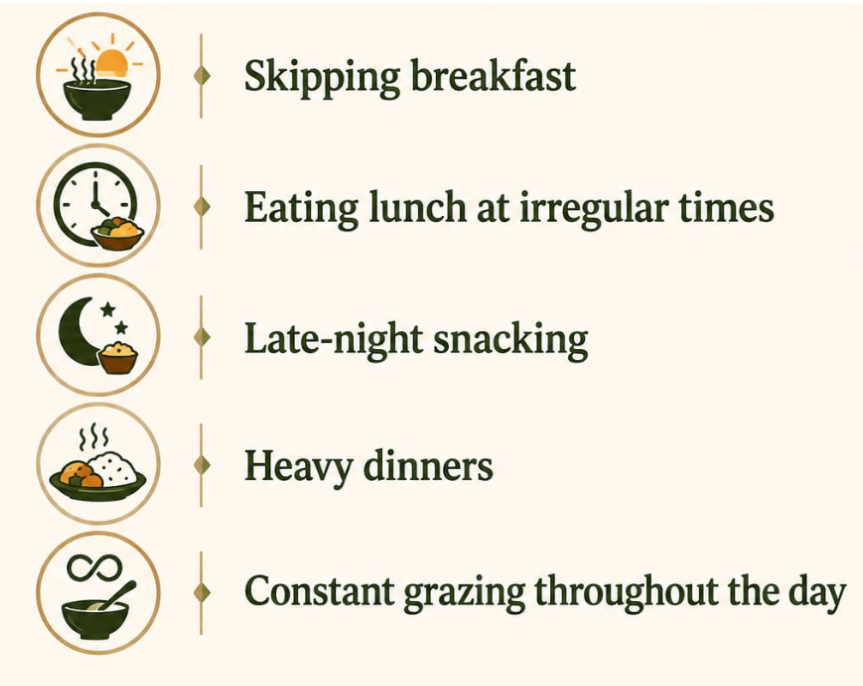
Over time, these habits weaken Agni and contribute to digestive imbalance.
Even healthy foods may become difficult to digest if eaten when the digestive system is not prepared.
The Problem with Late-Night Eating
One of the biggest concerns in Ayurveda is eating too late.
Many people consume their largest meal after work, often between 9 PM and 11 PM. At this time digestion is slowing down, metabolism is decreasing, the body is preparing for sleep. As a result, food remains partially digested and toxins begin to form.
Common signs include heaviness in the morning, acid reflux, constipation, poor sleep quality or weight gain.
Why Consistency Matters?
Ayurveda values routine.
Eating at the same time every day helps train the digestive system and supports healthy Agni.
The body begins preparing digestive enzymes and hormones based on expected meal times.
Benefits of consistent eating include better digestion, reduced bloating, stable energy levels, improved metabolism and better nutrient absorption.
Irregular meal schedules confuse the digestive system and weaken digestive efficiency.
Mindful Eating Is Part of Digestion
Ayurveda also emphasizes how you eat.
Many people today eat while working, during meetings, watching television or scrolling through phones.
When the mind is distracted, digestion becomes less efficient.
Ayurveda encourages mindful eating by creating a calm environment during meals. Rather than eating while working, watching television, or scrolling through a phone, individuals are encouraged to focus on the food in front of them. Taking time to chew properly and appreciate the meal helps activate the digestive process and improves both satisfaction and nutrient absorption.
Mindful eating improves digestion and enhances satisfaction from meals.
The Connection Between Digestion and Overall Health
Ayurveda teaches that digestion influences every aspect of health.
Strong digestion supports healthy skin, better immunity, stable energy, hormonal balance and mental clarity.
This is why Ayurvedic treatment often begins with correcting digestion before addressing specific symptoms.
When meal timing aligns with natural rhythms, the body can perform its functions more effectively.
Conclusion
Modern nutrition often focuses exclusively on food choices, but Ayurveda reminds us that timing is equally important. The healthiest foods cannot provide their full benefits if digestion is weak or meal timing is inconsistent.
By eating according to your body’s natural digestive rhythm, you support stronger Agni, better nutrient absorption, and long-term wellbeing. Sometimes the path to better health is not changing what you eat, but simply changing when you eat it.