


Paryushan is the most significant festival in Jainism, an eight-day period of reflection, self-discipline, and seeking forgiveness that culminates in Samvatsari. Shwetambar Paryushan 2026 runs from Tuesday, September 8 to Tuesday, September 15, with Samvatsari, the day of forgiveness, falling on September 15. Across these eight days, most observers shift to Chauvihar (no food or water after sunset), and many eat only one meal (Ekasana) or two meals (Biyasana) a day instead of their usual routine. That shift, more than the specific foods themselves, is what tends to unsettle digestion.
This guide explains why that happens from an Ayurvedic standpoint and which meal choices genuinely help, not just a list of dishes to try.
What Changes in Your Digestion During Paryushan
In Ayurveda, digestion depends on Agni, your digestive fire, and on keeping Vata, the dosha governing movement and elimination, from becoming erratic. Both are sensitive to routine. When meal frequency drops suddenly, as it does with Ekasana or Biyasana, or when there’s a long overnight gap from Chauvihar, Vata is the first thing to get disturbed. That’s what shows up as gas, bloating, dry stools, or a bloated feeling the next morning, not a failure of willpower or food choice.
The practical response isn’t to eat more; it’s to eat warm, moist, and easy-to-digest food within the window you have, so each meal does more work with less strain on Agni.
What to Avoid During Paryushan
Across nearly every Jain tradition, three things are avoided for the same reason: harvesting them kills the whole plant or risks harming the many organisms living around or on it.
- Onion, garlic, and root vegetables: potato, carrot, radish, beetroot, and fresh ginger or turmeric.
- Green leafy vegetables: spinach, methi, coriander, cabbage, and similar greens. Monsoon rain brings more insect life onto leaves that’s hard to fully clean off, and many households extend this rule to all eight days of Paryushan specifically, not just the wider monsoon season.
- Stale or leftover food, and anything that ferments overnight, since microorganism growth increases once food sits.
Where households differ: dried spice powders like turmeric and dry ginger (sonth), and fresh buttermilk churned the same day, are treated differently from fresh root vegetables or aged curd by many Gujarati Jain families, which is why they still appear in some dishes in this guide. Strictness varies by family and derasar, so follow your own household’s practice where it differs from what’s listed here.
This guide covers Shwetambar Paryushan. Digambar Das Lakshan (September 16 to 25, 2026) follows similar principles with an even simpler diet and isn’t covered in detail here.
Hydration During Chauvihar
Chauvihar governs water the same way it governs food: nothing after sunset until sunrise. During the day, many observers drink only boiled and cooled water rather than water straight from the tap or a filter, since boiling is considered to reduce the microorganisms present. If you’re also doing Ekasana or Biyasana, drink enough during the hours you have rather than trying to catch up early the next morning; a long overnight gap without water is itself a Vata-aggravating pattern, and starting the day already dehydrated makes it worse.
Lunch: The Main Meal, Timed With Your Strongest Agni
If your observance allows a fuller meal, take it at lunch rather than in the evening. Classical Ayurveda places Pitta, and with it digestive strength, at its peak around midday, so a heavier meal is genuinely easier to process then than the same meal eaten later.
Good midday options include:
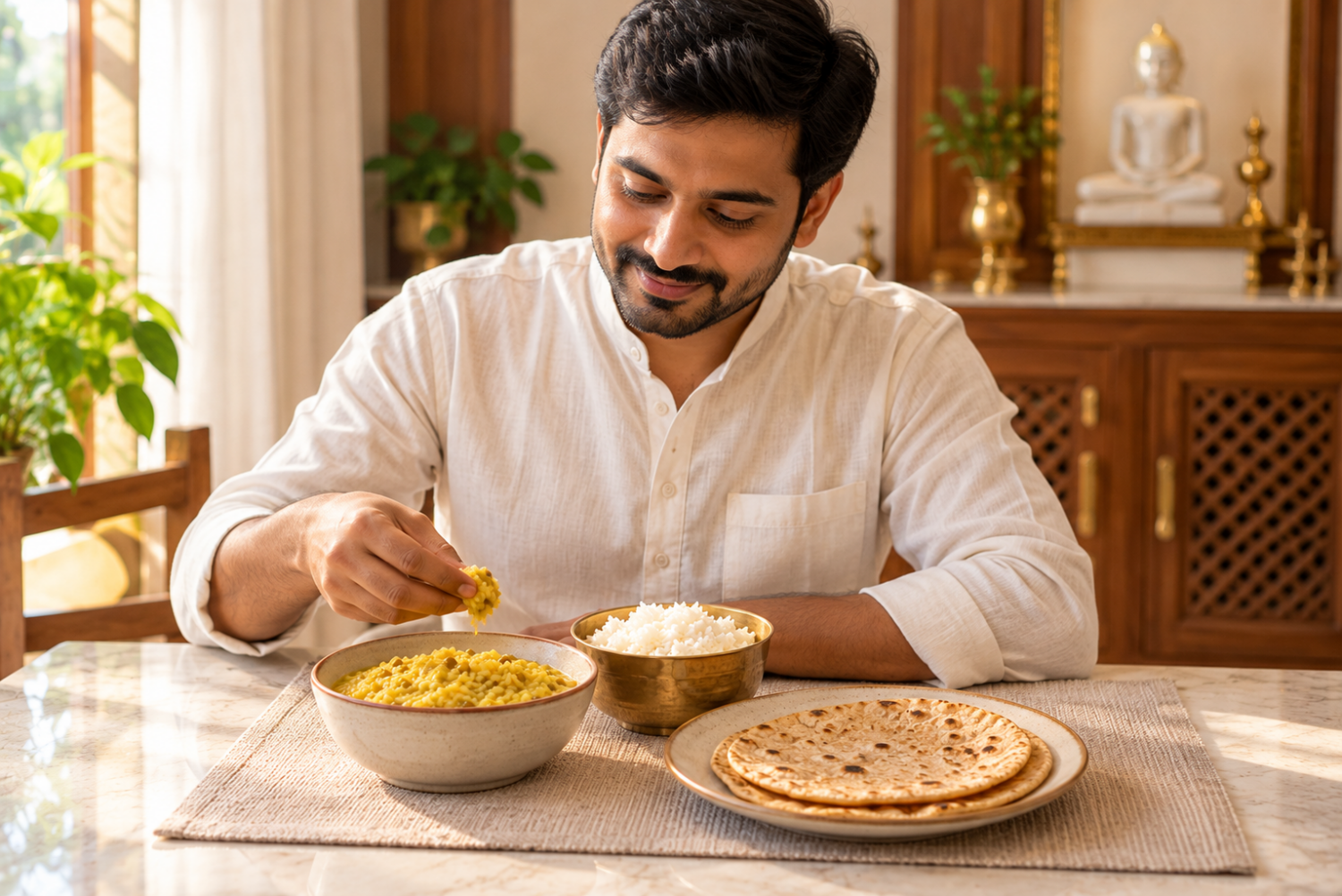
- Moong dal khichdi (soft-cooked yellow moong and rice)
- Savoury rice daliya with broken wheat and yellow moong
- Gujarati khatta mag (whole green moong)
- Gujarati kadhi with buttermilk and chickpea flour
- Vagharelo bhaat with ghee, turmeric, and cumin
- Coconut rice, papad ki sabzi, rasiya muthiya, spiced dhokli
Moong dal appears repeatedly for a reason: it’s considered tridoshic in Ayurveda, meaning it doesn’t aggravate any of the three doshas, and it’s classified as laghu (light), so it digests without taxing an already-reduced Agni.
If you’re including heavier legumes like chole, chana, or rajma, keep them to lunch and cook them in a thinner, more watery gravy rather than a dense one. Denser preparations sit longer in the gut and are harder to move through on a lighter eating schedule.
Breakfast and Light Meal Options
Where breakfast fits your routine, keep it simple rather than skipping straight to a heavy lunch on an empty stomach:
- Moong dal chilla with black pepper and cumin, or besan/oats chilla
- Roasted makhana (foxnuts) with ghee, rock salt, and pepper
- Thalipeeth or muthiya
Eat slowly and stop at a comfortable portion. On a reduced meal schedule, overeating at any single sitting is what most often triggers the heaviness people blame on “Paryushan food.”
Grains and Why Ghee Matters More Than Usual
Padvali roti, bajra rotla, and soft phulkas paired with ghee are a deliberate combination, not just tradition for its own sake. Fewer meals and an extended nightly gap without food or water tend to dry out digestion, which is a classic Vata pattern. Ghee is unctuous (snigdha) by nature, so a modest amount at meals counters that dryness and helps keep Agni steady rather than sputtering between meals. As a starting point, about half a teaspoon to a teaspoon per meal is enough; adjust up or down based on how your body responds. This is different from ghee as a general health food; here it’s doing a specific job tied to the eating pattern of the festival.
The Evening Chauvihar Meal
If your evening meal must be finished before sunset under Chauvihar, keep it thin and warm rather than a smaller version of lunch. A thin, strained moong dal soup (moong pani) tempered with cumin and ghee, spiced buttermilk, or warm water with dry ginger and fennel all sit light going into the long gap ahead. A heavy or oily dish this late, with nothing to follow it until the next day’s meal, is more likely to sit undigested overnight.
Reducing Gas and Bloating
A few specific habits address bloating directly rather than just avoiding trigger foods:
- Soak lentils and beans for 3 to 4 hours and discard the soaking water before cooking; this removes much of the oligosaccharide content that causes gas.
- Temper dals and legumes with hing (asafoetida), cumin, and dry ginger. All three are classic Ayurvedic carminatives that stimulate Agni and ease Vata-driven gas.
- After meals, chew a small mix of fennel, ajwain, and cumin seeds, roughly a quarter teaspoon of each, a combination that supports digestion and is gentle enough for daily use.
Sweets, Without the Guesswork
Ghee-based sattvic sweets like lapsi, atte ka sheera, moong dal halwa, khajur pak, sooji halwa, and doodh pak are part of Paryushan food traditions and don’t need to be dropped entirely. Keep portions modest and eat them alongside a meal rather than on an empty stomach, which slows the sugar hit. If you’re managing blood sugar, treat this as a category to be deliberate about rather than one to eliminate outright; talk to your doctor about how much fits your case.
After Paryushan Ends: Returning to Your Normal Diet
For most Shwetambar observers, Paryushan ends with Samvatsari on September 15. Those undertaking an extended fast such as the eight-day Atthai break it the next morning at Parna, September 16, traditionally with a small liquid first, moong pani or sugarcane juice, before any solid food.
Even if you ate through all eight days on Ekasana or Biyasana, your digestion has adjusted to fewer, lighter meals. Bring back oil, spice, and the vegetables you’d set aside over a day or two rather than all at once; Agni that’s been running light for over a week won’t necessarily handle a rich, heavy meal well on the first day back.
When to See a Doctor, Not Just Adjust Your Diet
Persistent abdominal pain, repeated vomiting, prolonged constipation or diarrhea, blood in stool, or unexplained weight change during Paryushan are not things to wait out with dietary tweaks. See a doctor. Dietary adjustment is for ordinary digestive discomfort, not a substitute for medical evaluation when symptoms are outside that range.
Reviewed by Dr. Priyanka Sampat Rajyagor, Ayurvedic Physician
This Paryushan diet guide was reviewed by Dr. Priyanka Sampat Rajyagor, M.D. (Ayu), P.G.DEMS, D.Y.A. Book a consultation with Ayurveda360 if you want this adjusted to your specific constitution, health history, or an existing condition.